Why Your Super Duty RIdes Like a Tank ( And How to Fix the “Tampa Jitter”)
Why Your Super Duty Rides Like a Tank (And How to Fix the "Tampa Jitter")
If you’re driving a 2011–2026 Ford F-250 or F-350 around Tampa, you know exactly what the "Super Duty Jitter" is.
You’re cruising down I-75 or crossing the Howard Frankland, and you hit one of those bridge expansion joints. The front end bounces, the rear end kicks, and your coffee almost jumps out of the cupholder. For a truck that costs as much as a luxury SUV, it certainly doesn't ride like one.
At PowerStroke Pros, we see this every day. Most owners think they just have to "live with it" because it’s a heavy-duty truck. But here is the truth: your truck is oversprung for your daily commute.
The Problem: The "Empty Bed" Curse
Ford engineers the Super Duty to handle massive payloads. That means the leaf springs and shocks are valved for when you have 3,000 lbs in the bed or a 15,000-lb gooseneck attached.
When you’re driving to the office or taking the family out to dinner with an empty bed, those springs have nowhere to go. They are too stiff to compress, so they transmit all that energy directly into the frame—and into your spine.
The Solution: Targeted Refinement
You don’t need a massive lift kit or a total suspension overhaul to fix this. To get a luxury-car feel out of a PowerStroke, you have to attack three specific areas:
1. Damping (The "Float" Factor)
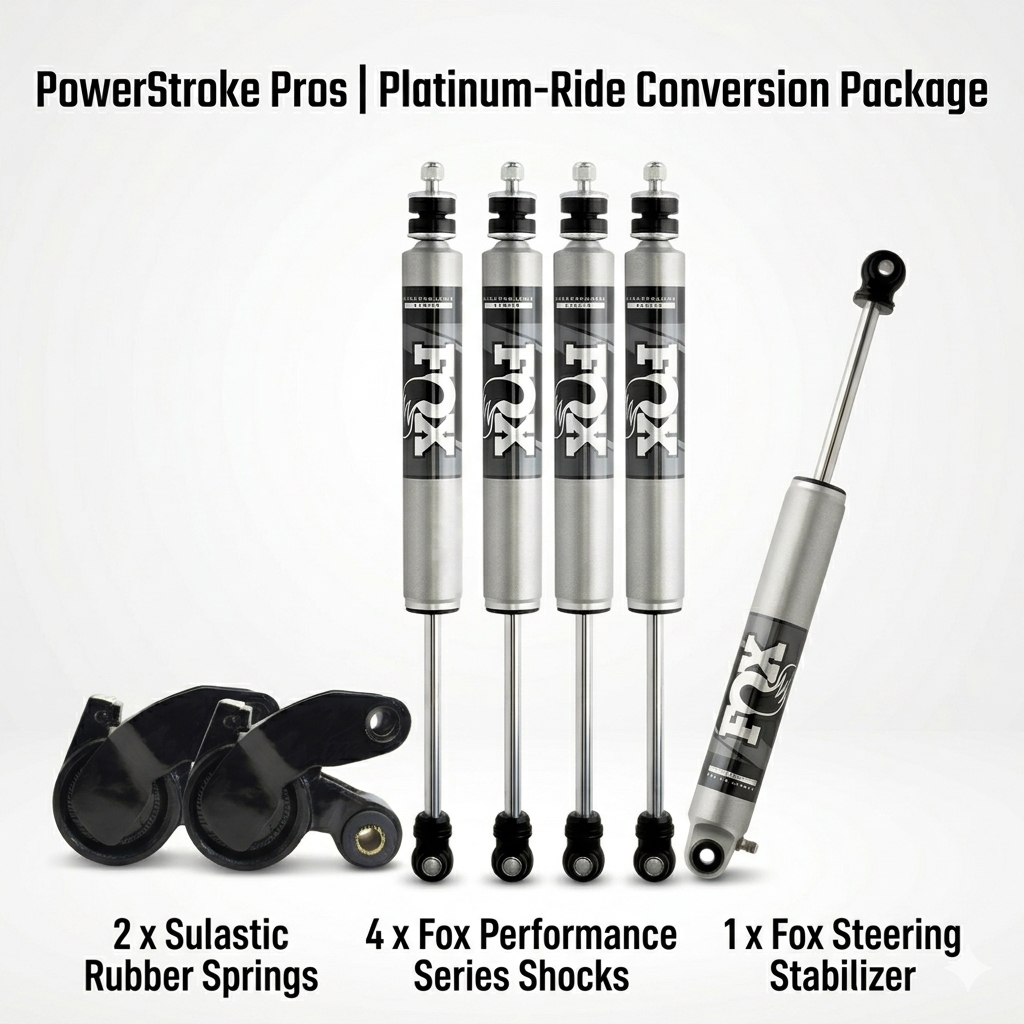
The factory shocks are basic twin-tube designs. They’re "lazy." Upgrading to a monotube shock with progressive valving (like the Fox 2.0 IFP) changes the physics of the ride. These shocks are designed to be "plush" over small road chatter but firm up instantly when you hit a major pothole. It gives the truck that "settled" feeling rather than the constant pogo-stick bounce.
2. Vibration Isolation
The rear leaf springs are connected to your frame by solid steel shackles. There is zero "give." By introducing a rubber-dampened shackle, you create a thermal break for vibration. It’s like putting a physical cushion between the road and the chassis. This is the "secret sauce" for stopping that harsh kick-back from the rear end.
3. Steering Feedback
Ever feel like you’re "white-knuckling" it at 70 mph because the steering feels flighty? That’s often due to the factory steering stabilizer failing to handle the weight of the PowerStroke engine and larger tires. A nitrogen-charged stabilizer weights the steering, making the truck track straight even when the asphalt is rutted or uneven.
Is It Worth It?
Improving your suspension isn’t just about comfort—it’s about driver fatigue. If you’re spending two hours a day in your truck navigating Florida traffic, a harsh ride wears you down.
When you tune the suspension specifically for the weight of the 6.7L PowerStroke, you get a truck that handles better, stops shorter, and finally feels as premium as the badge on the tailgate suggests.
Local Expert Tip
If you’re in the Tampa area and tired of your truck "jumping" over every bump on the Selmon Expressway, come by the shop. We’re Ford specialists, and we can walk you through exactly how these components work together. You don’t have to sacrifice your towing capacity to get a ride that your family actually enjoys.
Have you noticed your truck riding rougher as it gets older? It might be time to look beyond the factory shocks.
PowerStroke Pros Specializing in Ford Diesel Performance & Ride Quality Tampa, FL